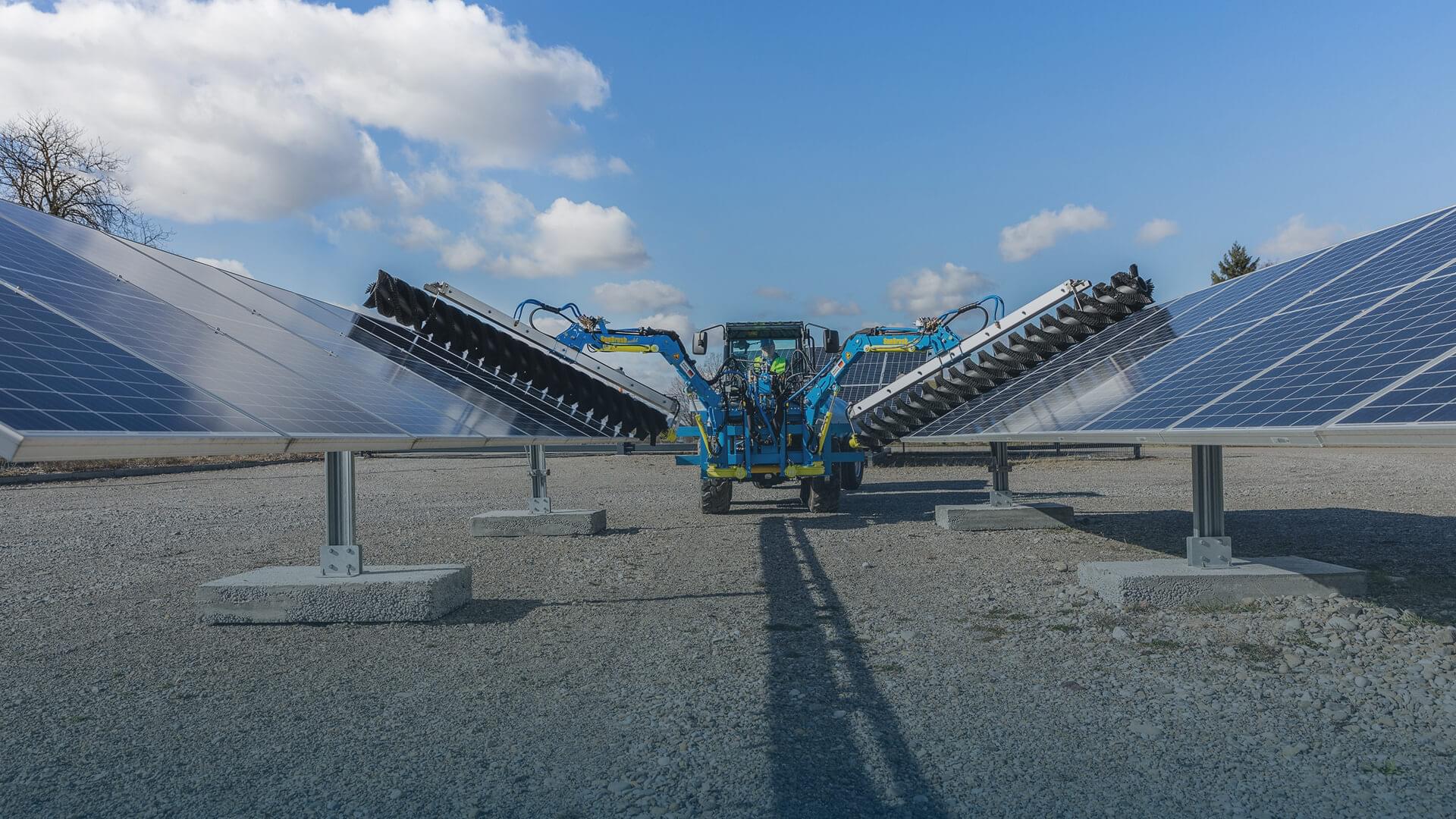
Cleaning open spaces efficiently
Large areas, long rows of modules and a wide variety of installation layouts place high demands on professional PV cleaning. Added to this are dust, sand, bird droppings and other deposits that can become permanently embedded in the modules.
sunbrush offers cleaning systems specifically designed for professional use on ground-mounted installations. From flexible solutions to high-performance vehicle-mounted systems for large solar parks.
Large areas. High standards.
With ground-mounted installations, it is not just a question of cleaning. The key is to clean large module areas efficiently whilst treating the modules with care.
Conditions vary from installation to installation. Row spacing, the height and length of the module tables, the terrain profile and the degree of soiling all influence which cleaning solution is best suited to the task. This is why, particularly in large solar parks, technology is required that can adapt to different conditions and deliver high area coverage.
Dirt reduces performance
Ground-mounted systems are constantly exposed to their surroundings. Dust and air pollution, leaves, pine needles or bird droppings can accumulate on the modules. Near roads or railway lines, for example, this is compounded by dust and grit kicked up by traffic.
The heavier and more stubborn the deposits are, the more important it is to carry out a thorough yet gentle clean. This helps to maintain the system’s performance and reduce yield losses caused by dirt.
How much loss could my
PV system suffer if it is not cleaned?
The sunbrush ROI calculator allows you to take your specific circumstances into account and better assess the investment in professional cleaning technology.
Sand and dust as a constant challenge
In arid regions and desert areas, the challenges are even greater. Fine sand and dust are constantly deposited on the module surfaces, where they can accumulate over large areas. In large-scale solar parks, this makes both cleaning performance and the efficient use of technology crucial. sunbrush cleaning systems are designed for professional use on large open spaces and enable mechanical cleaning even under demanding environmental conditions.
Bird droppings on the solar panel
A system contaminated with bird droppings poses a major challenge when it comes to cleaning. This is because bird droppings are among the most stubborn types of dirt and are extremely corrosive. On the one hand, this leads to greater cleaning effort and, on the other, can even cause chemical burns to the solar system. If bird droppings remain on the panel for too long, this has numerous consequences for photovoltaic system operators – there is a risk of significant losses in energy yield. You should therefore clean your solar system regularly using sunbrush systems and accessories.
The snow problem
Snow on PV modules can significantly reduce electricity yield in winter and, when there are large amounts of snow, can also place an additional strain on the system. With sunbrush, snow can be removed particularly easily and efficiently: The cleaning system is mounted on a support vehicle and clears the modules as it passes by using the swivelling brush roller. This ensures the system remains efficient even in regions with heavy snowfall, without the need for labour-intensive manual clearing of the modules.
The right solution for every installation
Ground-mounted installations vary considerably in size, design and accessibility. That is why sunbrush does not rely on a single machine for every situation. As a full-range supplier, sunbrush offers various cleaning systems to meet different requirements.
For large-scale solar parks, high-performance vehicle-mounted systems are available:
- Trackflex (2.0 / 3.0) – adaptable, flexible
- Eagle – compact for narrow aisles
- Rapid – compact cleaning with a mini-excavator
Depending on the structure of the installation and the operational situation, other solutions from the sunbrush portfolio may be utilised. This allows the cleaning technology to be selected to suit the installation and the planned application.